
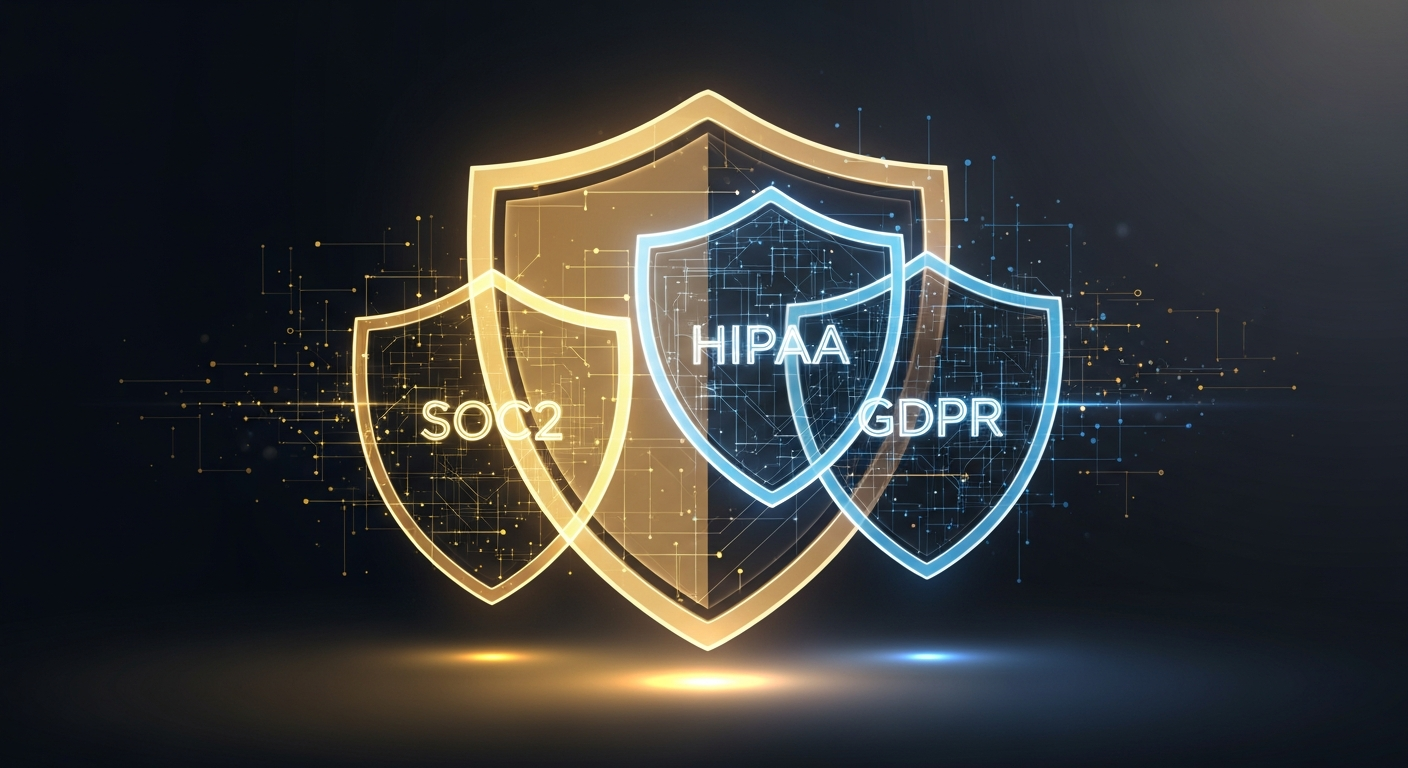
If your organisation operates internationally, handles health data, or works with enterprise customers, you're likely running multiple compliance programmes simultaneously. SOC 2 for your enterprise sales process. HIPAA if you touch health records. GDPR for any EU customer. PCI-DSS if you process payments. Each has its own requirements, its own audit process, and its own documentation burden — but they overlap more than most compliance teams realise.
The overlap opportunity
SOC 2 Type II, HIPAA, GDPR, and ISO 27001 all require roughly the same underlying security controls: access logging, encryption at rest and in transit, incident response procedures, vendor risk management, and evidence of regular review. The difference is in the documentation format, the audit process, and the specific technical requirements.
Organisations that treat these as completely separate programmes spend three times more on compliance than those who identify the common controls and implement them once. The key is a unified evidence base — a single source of truth that satisfies multiple frameworks simultaneously.
GDPR: Rights and discovery
GDPR's core requirements for data systems are Article 30 (records of processing), Article 17 (right to erasure), Article 20 (data portability), and Article 33 (breach notification within 72 hours). Each requires a level of visibility into your data that's simply impossible without automated tooling.
DBsafe's GDPR mode lets you maintain a live inventory of personal data processing, respond to Data Subject Access Requests (DSARs) with automated discovery, execute right-to-erasure requests across all connected databases, and generate Article 30 records that are always current.
HIPAA: Minimum necessary and audit
HIPAA's minimum necessary principle requires that access to Protected Health Information (PHI) is limited to only what's needed for a specific purpose. In practice, this means access controls at the column level, query-level audit logs, and the ability to demonstrate to auditors exactly who accessed what PHI and when.
DBsafe's audit log captures every query that touches PHI-flagged columns. Access control policies can be defined per database, per table, or per column. And the audit log is immutable — no admin can delete entries, which is a requirement under HIPAA's audit control standard.
SOC 2: Controls and evidence
SOC 2 Type II auditors want evidence that your controls worked continuously over the audit period — typically 12 months. This means access logs, configuration change history, incident records, and evidence of monitoring. DBsafe exports audit trails in formats that map directly to the SOC 2 Trust Service Criteria, reducing the time your engineering team spends responding to auditor requests from weeks to hours.
Building a compliance-native culture
The teams that handle compliance most efficiently aren't the ones with the biggest compliance departments — they're the ones who've made compliance a property of their systems rather than a separate process layered on top. When every database query is logged, every PII field is tracked, and every masking decision is auditable, compliance becomes the default state rather than the exception.